Advocacy for London’s Homeless

From: Catholic News Agency 28th July 2020

Fr. Dominic Robinson, pastor of Farm Street Church in Mayfair, told CNA the newly homeless would require government support in order to survive the crisis.

“It’s going to be a long haul. I think that they’re going to need a lot of help. They are going to need charitable help from faith groups, including the Church. They’re also going to need local authorities and national government to be on their side,” he said.

Robinson explained that many of those on the streets were unable to receive public funds because their immigration status was unclear. Some of the new homeless are from the 30 countries within the European Economic Area, but many come from outside Europe. 

He said: “There are a large number of newly homeless on the streets who have lost jobs, especially in places like the hospitality sector, who fall into a category of ‘no recourse to public funds.’ This is largely because of their unsettled status. Their status as a refugee hasn’t been verified yet.” 

“And so they fall into this limbo. They lose their jobs, then they lose their home and they have no access to benefits.”

When the government imposed a lockdown in March to curtail the spread of the coronavirus, around 15,000 homeless people were placed in hotels. Around 4,000-6,000 of them were categorized as having “no recourse to public funds,” which meant that they were not normally eligible for housing support. 

Robinson said: “We’ve been advocating that the government give a temporary reprieve on ‘no recourse to public funds’ because we’re seeing a large number who would be barred from benefits and who’ve been on the streets of London — and I’m sure other places up and down the country — at the time of a great public health risk. That’s not acceptable.” 

In a July 3 interview with the BBC’s Newsnight program, Cardinal Vincent Nichols of Westminster also urged the government to continue providing assistance to those who are formally barred from receiving public funds.

He said: “Well of course some people are here without proper paperwork. Of course they are. We know that. That’s been a fact of life in this country for many, many years.”

“But at this point we should be prepared to put all those things to one side and deal with the person in front of us. This is a human being whose life is full of trauma. They are here. We need to respond to that humanity in front of us, recognizing the innate dignity of each person and not simply consign them into an abyss.”

Robinson has served London’s homeless population throughout the crisis. When lockdown was imposed in March, the local authority, Westminster City Council, asked him to offer refreshments to the needy in Trafalgar Square, while the nearby parish of St. Patrick’s, Soho Square, provided food to more than 200 people a day.

“So at Farm Street we got together a team of local parishes — Westminster Cathedral, Holy Apostles, Pimlico, Holy Redeemer, Chelsea — and worked with Caritas Westminster to set up a project which five days a week served up to 200 homeless at its peak,” he said. 

“The refreshments were provided from people’s donations — people were very, very generous — and from local hotels, such as No 45 Park Lane at the Dorchester. We were working with the Connaught Hotel and Claridge’s, within Farm Street parish, to provide the food for the St. Patrick’s, Soho Square, service.”

The Jesuit priest said volunteers noticed that many people seeking refreshments were newly homeless. 

“What we were seeing was that a lot of people who were working for hospitality agencies — restaurants, pubs, hotels — were losing their jobs. So it seems to be an effect of the pandemic that there is now this even more serious crisis of many people who’ve lost their jobs who’ve become destitute — many of whom are homeless, some who are not homeless but have very little to live on — and so need a good deal of help.”

Robinson said he had experienced “a real mixture of emotions” while serving the homeless during the lockdown.

“It’s been wonderful to see the great generosity of our volunteers. It’s great to see the Church playing such an important role of serving those who are most vulnerable at this time,” he noted.

“It also breaks your heart — as it has done for a lot of our volunteers — to see young men and women in their 20s and 30s who have lost jobs, who have broken relationships, who’ve lost their way in society during this dreadful crisis.”

He continued: “There was one day when we had a large queue in Trafalgar Square. Because the volunteers had built up a very good relationship with the regular guests, they were chatting quite freely, getting to know them. And a guest had asked for some rosary beads and he was being given them. Then a whole group of guests came and also asked if they could have rosary beads.” 

“So you realized there was that connection being made between the Church and the Catholic faith and this charitable work. That was really quite inspiring to experience.” 

As the lockdown eases, the volunteers have moved from Trafalgar Square to a new base.

“We’ve been asked to set up a service in Warwick Street at the Church of Our Lady of the Assumption and St. Gregory, the ordinariate church,” Robinson said. 

“There, we’re providing showers for the homeless, and some help with IT, so that people can be helped to apply for jobs, and we’re just building that up at the moment. And we’re getting a steady stream of homeless, many of whom, again, are newly homeless.” 

Robinson suggested three ways in which Catholics can help the new homeless.

“Obviously at this time, when so many people are not able to go out very much, maybe have more time on their hands, it’s to pray — to pray for the homeless and to pray for the work which is going on for them and with them,” he said. 

“It’s to raise awareness as well — the second thing — to find accurate information about what’s going on. Because there’s a lot of fake news around. There’s a lot of fuzzy information, but to actually find out what’s really going on with the homeless on the street and to realize that it’s a much more serious state of affairs than some people might have us to believe.”

“And the third thing would be charity. We’re looking for more volunteers at Warwick Street. But also funds. While we need to hold local authorities to account in providing funds, we also do still need funds to continue to provide these services. So it’s prayer, more information, real information, and charitable action.”

Robinson said many of the newly homeless would struggle to get off the streets and return to employment.

“We need to keep advocating for them, for this most vulnerable group of people, and we need to keep them also hopeful, I think, through our presence in looking after them,” he said.

A Catholic Response to George Floyd and Black Lives Matter

Article by Ellen Teague, Independent Catholic News

“When you say, ‘I’m not racist’, you deny structural injustice” an African-American woman from the United States told a Westminster Justice and Peace zoom meeting on Friday. More than 65 people joined the meeting, ‘A Catholic Response to George Floyd and Black Lives Matter,’ where Leslye Colvin, speaking live from Alabama, deplored “racially segregated Christianity”. She highlighted the conflict between lived experience in her country and American ideals, saying that Catholic Social Teaching calls for Catholics to demand justice for all our neighbours. She felt “patriotism and faith” is fuelling nationalism in the US, but we must be, “ruled by a love and build the beloved community”.

Leslye lamented the recent killings of George Floyd and three other black people. “They were murdered because of systemic racism” she said; “it could have been me; maybe it will be me the next time.” Seeing colour is not the problem, she felt, but judging people because of colour. Referring to the particular discrimination experienced by the black community, she suggested that, “when you say ‘all lives matter’, you deny our lived experience”. She invited participants in the meeting to become allies and, “take one step at a time, for this is not a sprint, it’s a marathon, for the roots of racism are deep within our societies”. Leslye said she appreciated, “knowing I have brothers and sisters in the UK”.

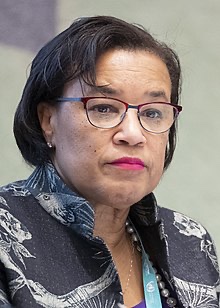
The second speaker was Baroness Patricia Scotland of Asthal, QC and Secretary General of the Commonwealth of Nations. She is a dual citizen of the UK and the Caribbean island of Dominica, where she was born, and was the first black woman to be appointed a Queen’s Counsel. She spoke about ‘Black Lives Matter’ from the UK perspective, saying, “US experience is mirrored here – it’s a common global experience”. She agreed that racism is systemic and endemic. Describing herself as a Catholic “of the Windrush generation,” she remembered as a child seeing TV images of black children being hated and shot at in South Africa and asking ‘Why?'” She saw similar images in the south of the United States. “Being black meant I would be spat at, beaten up on way home,” she reported, and “growing up, there was a feeling that black people could not achieve”. However, she was also taught that, “each of us had a gift from God and we have to use it.” 

She felt the Commonwealth has been radical, wanting mixed sport, for example. It has not accepted discrimination, and in 1953, Queen Elizabeth ll described the Commonwealth as a new concept of the best of humankind. The story was highlighted of the queen breaking barriers by dancing with President Kwame Nkrumah of Ghana in 1961, demonstrating her acceptance of a new footing between their countries.

Baroness Scotland felt, “our humanity is on trial, and the George Floyd case highlighted this”. She suggested we must reflect on what Christianity means for us? “Christianity is not something we do but something we are?” and she reflected, “there are no races in God’s eyes – just one race, the human race”. She called for the election of leaders better able to address the issue and for prayer and action for racial equality.

The meeting on 24 July was the most ethnically diverse I have been on and with a strong international dimension, with participants from several parts of the United States and the Zimbabwean Chaplain in London. Catholic groups represented included Catholic Association for Racial Justice (CARJ), Newman House Chaplaincy, Caritas Westminster, Catholic Children’s Society, Pax Christi and Columban JPIC. A range of Westminster parishes included Holloway, Royston, Pinner, Finsbury Park, West Green, Twickenham, Eastcote, Euston, and Wealdstone. There was participation from Southwark, Hexham & Newcastle and Clifton dioceses as well, showing the considerable interest in the subject.

Fr Dominic Robinson, SJ, Parish Priest, Farm Street Church of the Immaculate Conception and chair of Westminster Justice and Peace Commission, said “this was an inspiring and challenging evening”. He feels “racial justice is central to Catholic Social Teaching and so to all our lives as Church”. 

The Chair, Suddie Komba-Kono, said she was disappointed with Church silence in the UK over ‘Black Live Matter’. Many seemed to agree, saying in the chat that the Church, particularly priests, have a responsibility to highlight racism as a sin as is done for other social justice issues. “Even black parish priests don’t preach about racism during times when racial injustice takes place, which is very disappointing” was one comment, and “the Church needs to pay attention to ensuring that the clergy and those in leadership positions access ‘Cultural Competence’ training as part of their preparation for leadership and service to the faithful.” Lorna Panambalum, a black teacher, commented that education is key and, “we need to look at the structure of our education system”. She asked, “how are we making sure we know the history of racism in our society and Church?”

Participants agreed we have a special opportunity at this time for learning about structural racism. The Quaker ‘Black Lives Matter’ five-week seminar course was recommended, which has an extensive reading and resource list. It was felt that the Quakers have always been activists on the race issue, being against the Trans-Atlantic slave trade and supporting abolitionist efforts and now their ‘Black Lives Matter’ initiative.

LINKS:

Leslye Colvin at: https://leslyeslabyrinth.blogspot.com/

Article by Baroness Scotland:  https://news.trust.org/item/20200608160407-7o4ug/

Being Black and Catholic + Videos – Produced by Westminster Diocese – www.indcatholicnews.com/news/40033

Black Lives Matter: Learning for Quakers: www.quaker.org.uk/events/blacklivesmatter

The history (and teaching) of racism was addressed in the recent Cumberland Lodge webinar series, with recordings on their website www.cumberlandlodge.ac.uk/project/dialogue-debate-black-lives-matter

E-Bulletin July 2020

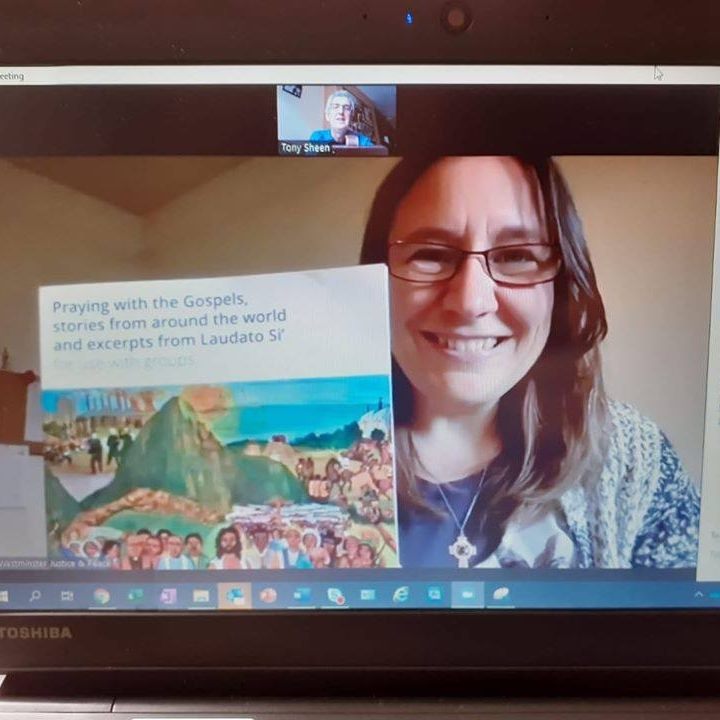
Colette Joyce, Westminster Justice & Peace Co-ordinator, practises for the Caring for Creation Zoom Webinar

For us at the Commission, it has been an important month for conversation and dialogue, as we try and grapple with the ‘new normal’ and reflect on the world we are trying to build as we emerge, tentatively, from coronavirus lockdown measures. What have we learnt to do differently that we want to keep? What do we need to change?

Last week we held a webinar to help parishes and other organisations prepare for the Season of Creation 1st September – 4th October, with people attending from all over the Diocese and beyond. A Zoom recording of the event is available to view on our website, along with a page of resources to get you started. Please let us know about any ideas, reflections and other resources you may have…

Resources for the Season of Creation   

We are also looking forward to our next webinar on racial justice on Friday 24th July, 7.30-8.30pm. Please sign up and join us in reflection on our response as Catholics, individually, as a Diocese and as an international Church:

A Catholic Response to George Floyd and Black Lives Matter

More details for both these events and more can be found in the E-Bulletin. Please download and share.

CAFOD Join DEC Coronavirus Appeal

CAFOD have joined forces with the Disasters Emergency Committee (DEC) to scale up our response, ensuring that no one is beyond reach of the aid they need to survive.

Families who have been forced to flee their homes and have lost everything in places like Syria, South Sudan and DR Congo are particularly vulnerable to the virus.

For countries that have had years of conflict, people will struggle to access healthcare. Lockdown in these countries means that many people will suffer a huge loss in income, pushing people further into poverty and putting millions at risk of hunger and malnutrition.

For refugees, such as the Rohingya refugees in Bangladesh, overcrowding and a lack of hygiene facilities in refugee camps means that the spread of the virus will be devastating.

How can I help?

In order to continue protecting and improving the lives of those in poor communities, your gifts are needed now more than ever. Your essential support will help families survive.

DONATE TO CAFOD

Catholic Union call for answers on homelessness with Justice & Peace and Catholic charities

We have partnered with the Catholic Union and front-line Catholic charities in London and around the country to appeal strongly to the government for support schemes to be made available to people with ‘No Recourse to Public Funds’ (NRPF) for the duration of the pandemic emergency.


The Catholic community stand ready to give charitable and voluntary assistance, wherever statutory services are provided, to enable people resolve their precarious life situations and return to self-sufficiency.

Homeless queue outside National Gallery
Homeless queue outside the National Gallery, London

The Catholic Union and other church groups in London have warned of a rough sleeping crisis, unless the Government acts soon.

Around 15,000 people across the country have been housed by local authorities since the start of the coronavirus pandemic. This has been made possible by extra funding from the Government to provide accommodation for rough sleepers in empty hotels and hostels as part of the “everyone in” scheme. This includes 1,400 people in London.

Many of the contracts between local authorities and accommodation providers are due to come to an end shortly, as hotels are allowed to reopen from 4 July. The Government has announced £85 million of new funding to secure alternative rooms for rough sleepers, such as student accommodation. But church groups are worried this has come too late for some people, and there is no extra help for the growing number of people still on the streets.

The Government has said it is committed to meeting the needs of rough sleepers to ensure “that as few people as possible return to the streets.”

Dame Louise Casey has been asked to lead a taskforce on providing long-term solutions to ending rough sleeping. But no timescale has been given for this work, and church groups are worried that time is running out to produce a plan.

In a letter to Dame Louise, the Catholic Union has called for all people currently given shelter by the “everyone in” scheme to be housed permanently. It also highlights the challenges faced by rough sleepers with no resource to public funds.

The letter was sent on behalf of the Justice and Peace Department of the Catholic Diocese of Westminster, who are working in conjunction with Caritas, the social action department of the Diocese of Westminster and the Jesuit Refugee Service UK.

Chair of Westminster Justice and Peace, Fr Dominic Robinson, commented: “During the lockdown the central London Catholic Churches have been working nonstop with local businesses and government to help the many rough sleepers still on our streets. Some funds are being promised to rehouse the homeless currently in hotels but now many more men and women who’ve lost jobs and become destitute are pouring onto our streets. This catastrophe is avoidable if there is a temporary reprieve for the growing number of destitute who have no recourse to public funds. If public funds are made available for this group of people left on the streets, we stand ready to work together for what we all want – a permanent and holistic solution to this affront to human dignity which sees those who have lost everything with nowhere to turn”.

Catholic Union Head of Public Affairs, James Somerville-Meikle, commented: “The new funding from the Government is a step in the right direction, but it has come late in the day. Many rough sleepers face being turned out of hotel and hostel rooms in the week ahead. Whilst the long-term commitment to end homelessness is welcome, we need an immediate plan for how to prevent a rough sleeping crisis. Church groups stand ready to be part of the solution and can help get support to some of the most vulnerable people in society – people that government services often struggle to reach.”

Read the full letter here:

Dame Louise Casey
Chair, Taskforce on Rough Sleeping

Dear Dame Louise

Re: Contribution of church groups to tackling rough sleeping

I’m writing to you on behalf of the Catholic Union and several church groups involved in helping the homeless in London.

They include a number of parishes and social action groups within the Catholic Diocese of Westminster – Caritas, and Justice and Peace – who have been working with the London Passage and the Jesuit Refugee Service UK.

Representatives from Caritas Westminster and Westminster Justice and Peace would welcome the opportunity to brief you on the work they are doing, the challenges they face, and the help they can provide, in finding a long-term solution to ending rough sleeping.

The Catholic Union is the leading representative group for lay Catholics in Britain. We seek to promote the views and interests of the 4.5 million Catholics in this country.

The Catholic Church has a rich history of helping those in need, particularly at times of crisis, including the homeless, and has been the principal provider of emergency food and pastoral care for the homeless during the lockdown as all the usual day and night shelters have been closed.

We welcome the work of your taskforce in looking at the causes of rough sleeping and producing recommendations to Government on ending homelessness. This work has clearly been given greater importance and urgency in light of the coronavirus pandemic.

The extra funding given to councils to support rough sleepers during this crisis has been a step in the right direction. The “everyone in” scheme has helped to get thousands of people off our streets and into secure accommodation. This has been a fantastic example of good co-operation between local and central government, charities and the private sector.

The Catholic Church, along with other volunteer groups, has played its part by helping local authorities get rough sleepers housed during this crisis and looking after those still on our streets with an enormous feeding programme through our parishes’ contact with large London hotels who have spent hundreds of thousands of pounds on this operation.

However, there are concerns about what will happen when existing funding for the “everyone in” scheme comes to an end. The policies below would make a huge difference is tackling homelessness once and for all.

1. A guarantee that the Government will extend housing support for all those currently in hotels, to support their move to new homes where this cannot be provided by local authorities.

A temporary reprieve for all those with no recourse to public funds in relation to support available to help the homeless, this would be in line with existing discretion with regard to destitution (section 95 of the Immigration and Asylum Act 1999). This should include those who have exhausted their rights or have no current legal status.

Access to free legal advice concerning the rights of individuals to seek and receive help if they are homeless.

We sincerely hope your taskforce will consider these points and make recommendations on them when you report to the Communities Secretary and Prime Minister.

Church groups stand ready to be part of the long-term solution and can help get support to some of the most vulnerable people in society – people that government services often struggle to reach.

The leader of the Catholic Church in England and Wales, Cardinal Vincent Nichols, recently commented: “In 2020 no person should be faced with the indignity of being compelled to sleep on the street or the dangers and challenges associated with doing so… Only by working together can we find just and permanent solutions for the people who are homeless. I hope and pray that the new momentum found during this crisis can be sustained and will be successful.”

The Catholic Union would be delighted to help arrange a meeting with you to discuss the contribution of church groups in London to tackling homelessness. A meeting need not take long, but it might help provide a useful insight at this crucial time for the work of your taskforce.

If this is of interest, I would be pleased to discuss details with your office.

Let’s use this moment to end rough sleeping once and for all in this country.

Nigel Parker

Director
The Catholic Union of Great Britain Email: director@catholicunion.org.uk

Catholic Union of Great Britain

Press Statement on the scheduled annexation of Palestinian West Bank territory on 1st July 2020

“Westminster Justice & Peace Commission stands with people of the Holy Land in the face of plans for unilateral Israeli annexation of West Bank Palestinian territory, scheduled for 1st July 2020. Our condemnation follows that of the united Church leadership in the Holy Land, the Catholic Bishops’ Conference of England and Wales, and that of the Cardinal Archbishop of Westminster with the Archbishop of Canterbury. Prominent Jewish  members of British society have also expressed alarm at the prospect.

Annexation will all but destroy chances for a negotiated peace, further limiting prospects of establishing a Palestinian state. More violence is likely and  the lives of Palestinians, suffering already under Israeli occupation, will be further degraded.  It will do nothing to enhance Israel’s standing in the world.

The Commission calls on Israel and the United States to respect International Law and existing UN resolutions and to abandon such a reckless plan, in the name of justice and peace.”

Statement on the Annexation from the Catholic Bishops of England and Wales, 24th June 2020

People Not Walls Virtual Rally on World Refugee Day 20th June 2020

 People Not Walls is the Anglo-French initiative which brings together organisations on both sides of the Channel for migrant rights. This event focuses on the plight of unaccompanied minors experiencing human rights abuses near the French coast and embarking upon perilous Channel crossing attempts in small boats. The Rally will end with a switch to the live Memorial Service at Dover. Free registration in advance.

Registration: Keep Children From Danger Online Rally

Livestream: Dover 20th Anniversary Memorial Service for 58 Chinese Migrants

Climate Sunday launched. Churches invited to take part from Sunday 6th September 2020


‘Climate Sunday’ has been launched to provide a focus for churches across Britain and Ireland committed to action on climate change.

Climate Sunday has been organised by the Environmental Issues Network of Churches Together in Britain and Ireland, supported by charities including CAFOD, Christian Aid, Tearfund, A Rocha UK, and Operation Noah.

Local churches are encouraged to hold a Climate Sunday any time during a one-year period from 6 September 2020 – the first Sunday in the annual Season of Creation.

Free resources are being provided to suit every tradition and style of worship. Each church is invited to do one or more of three things:

1. To hold a climate-focused service to explore the theological and scientific basis of creation care and action on climate, to pray, and to commit to action.

2. To make a commitment as a local church community to taking long term action to reduce its own greenhouse gas emissions.

3. Join with other churches and wider society by adding its name to a common call for the UK government to take much bolder action on climate change in advance of COP26, and to strengthen its credibility to lead the international community to adopt a step change in action at COP26.

The culmination of the campaign will be a national Climate Sunday event on Sunday 5 September 2021, to share church commitments and pray for bold action and courageous leadership at the COP26 UN climate talks in Glasgow in November 2021.

Bishop John Arnold of Salford, the bishop responsible for the environment for the Catholic Bishops of England and Wales, said: “We need to recognise the damage we’re doing to the environment and our failure to look after our brothers and sisters in our common home. In a post-pandemic world, the Climate Sunday project is an excellent opportunity for Catholic parishes in England and Wales, as well as our ecumenical brothers and sisters, to understand responsibility to heal our planet and to pray and act in response to the climate emergency.”

To register for Climate Sunday visit: www.climatesunday.org

Original article on Independent Catholic News